45% of execs limit human AI oversight to high-stakes work, or don't have any oversight at all

Every manager eventually learns that "use your best judgment" is a wager. You're betting the person's judgment resembles yours closely enough that you won't hear about the outcome from Legal.
Companies are now placing that bet with software. An AI agent can have access to the company card, email account, and every customer record, even though its judgment can be, putting it nicely, flawed. AI often won't push back against your ideas even if they wouldn't pass a human sniff test. It was built to do what it can with what it was given.
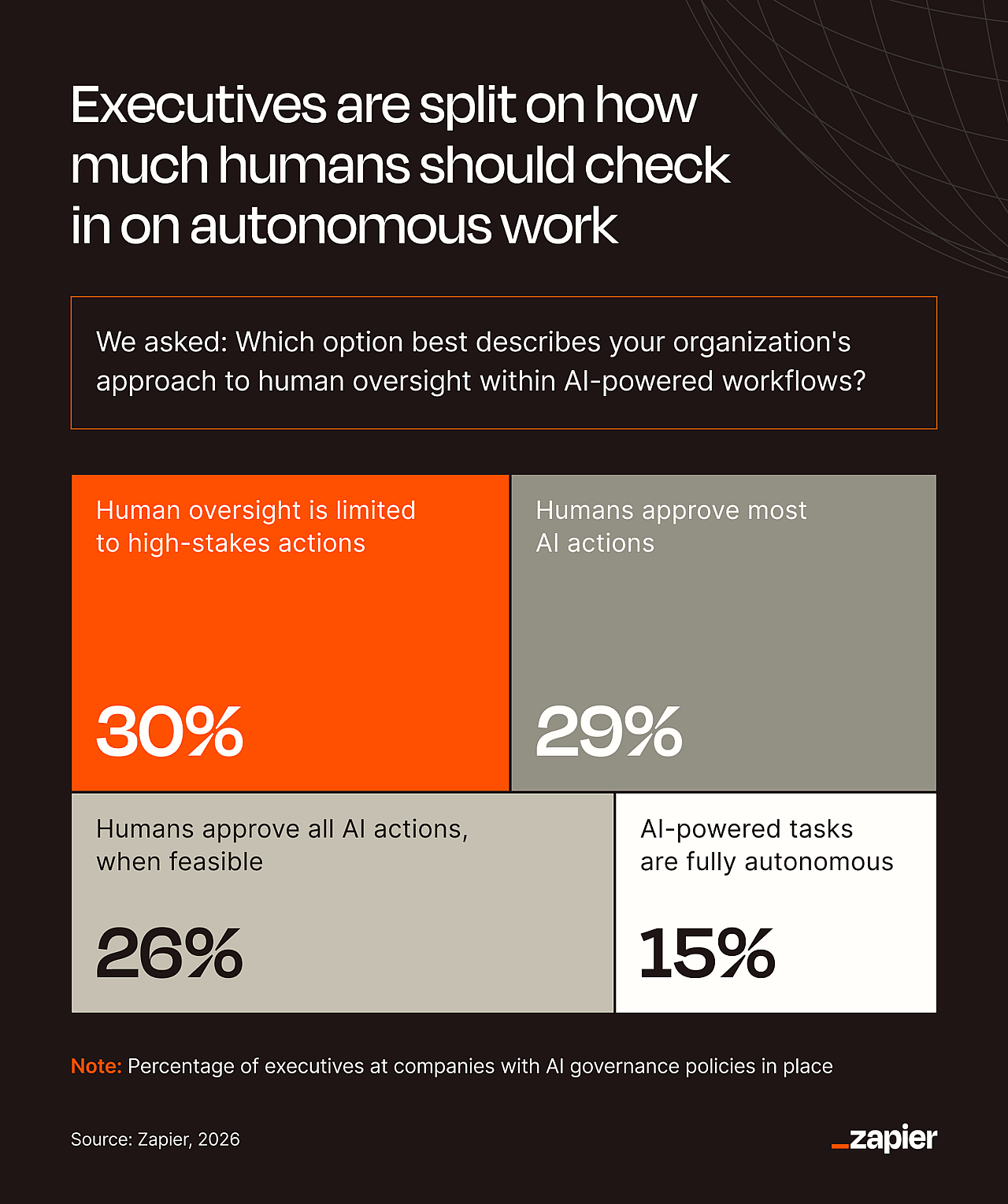
With AI at the helm, humans typically need to step in at some point to review work and course-correct if necessary. But companies have wildly different ideas of when to do that, or if they should do it at all. Nearly one-third (30%) of executives give AI autonomy on most tasks and step in only for high-stakes actions. Another 15% have handed over full autonomy.
In a survey of 518 executives, Zapier exclusively interviewed people at companies with an AI governance policy. And the findings show that policies alone aren't enough to ensure that AI works the way you intended.
Key findings:
- 15% of execs say their company gives AI full, unsupervised autonomy
- 38% say unsupervised AI has already cost them time, money, or reputation
- 49% of execs personally trust AI to make most decisions without human review
15% of execs say their company gives AI full, unsupervised autonomy
Say you have an AI agent that handles vendor invoices. It reads each one, matches it against what you ordered, and pays it. Sign off on every payment, and you've just become accounts payable. Sign off on none, and it wires $5,000 to a spoofed invoice because the letterhead looked official.
Companies usually land somewhere between these two levels of oversight, but there's no consensus on where. While most (85%) executives say their companies have some human approval or oversight on AI-powered work, the approaches split three ways:
- A light touch: Nearly one-third (30%) give AI autonomy on most tasks and intervene only for high-stakes actions.
- Heavy oversight: A similar percentage (29%) say humans approve most AI-powered actions.
- Heaviest: 26% approve every AI-powered action that's feasible to review manually.
The remaining 15% aren't drawing a line at all: Their AI-powered tasks run fully autonomously without human approval.
If a company has a governance policy, its human-in-the-loop (HITL) directions could outline when people should check AI outputs, what to look for, and how to prevent mistakes. The best AI tools include built-in human-in-the-loop options to create a clear paper trail of AI's decisions.
38% say unsupervised AI has already cost them time, money, or reputation
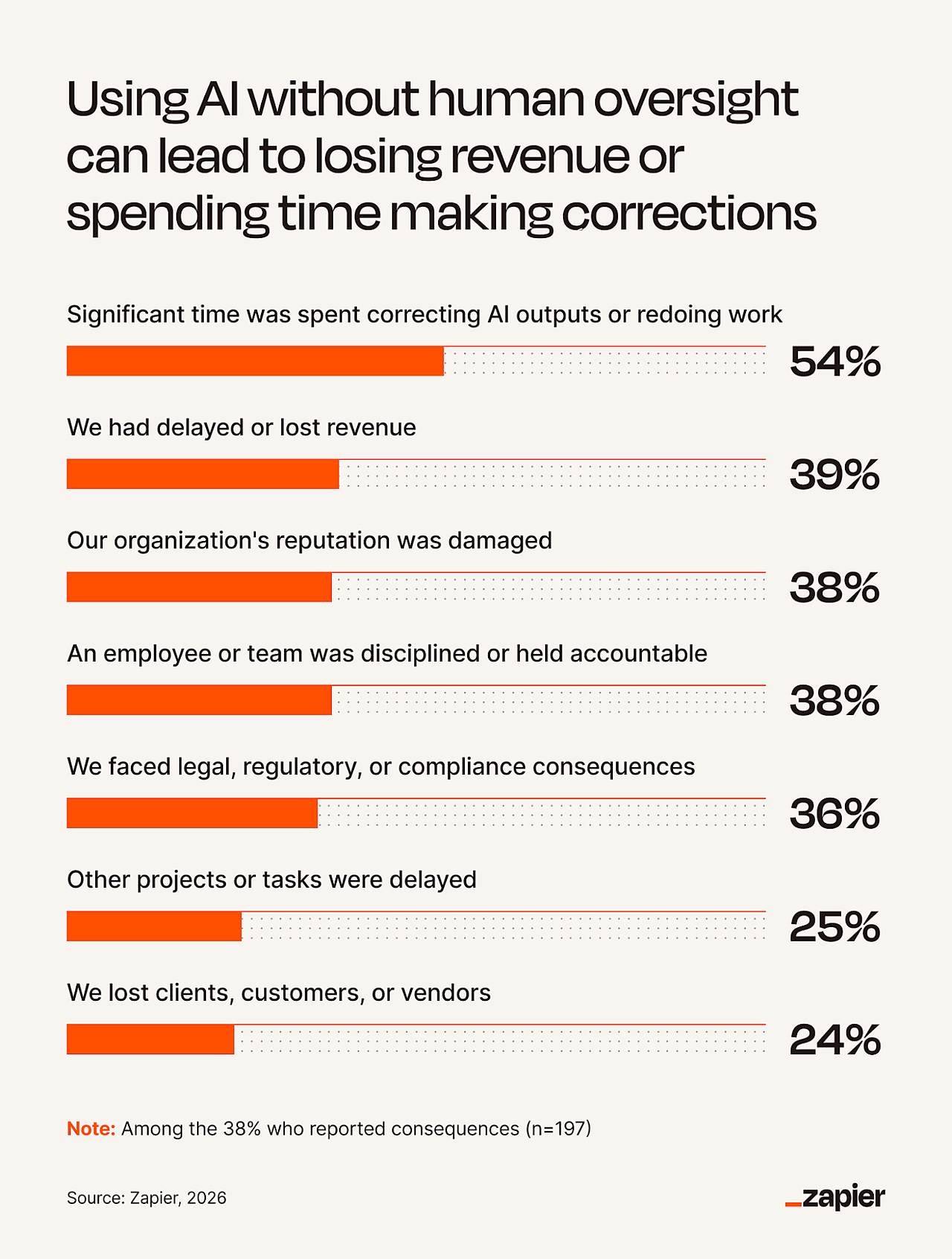
Without some oversight over AI actions, companies can face costly problems. More than one-third (38%) of executives say their company has faced negative consequences after using AI-powered tools without human review. Among that group:
- 54% spent significant time correcting AI outputs or redoing work
- 39% had delayed or lost revenue
- 38% saw their organization's reputation damaged
- 38% disciplined or held an employee or team accountable
- 36% faced legal, regulatory, or compliance consequences
More oversight looks like the obvious fix, but executives who've lived through the problem disagree: 49% of those whose organizations have experienced AI-related issues say their workplace has too much oversight of AI-driven workflows, compared to only 9% at companies that haven't had problems.
There are two ways to read that. One is that heavy oversight creates its own failures, with reviewers rubber-stamping work they don't have time to actually check. The other is that companies watching AI closely are simply the ones who notice when it goes wrong.
Both point in the same direction: Adding more reviewers to a process that's already producing bad output doesn't fix the output. If you keep catching the same class of mistake, the problem is where the checkpoints sit, not how many of them there are.
If your team is going to scale AI-powered automation, you'll need to develop a governance system that gives full visibility on who's approving AI outputs.
49% of executives personally trust AI to make most decisions without human review
Rubber-stamping has burned some companies, but it hasn't dampened enthusiasm much: 49% of execs say they personally trust AI to make most decisions without human review.
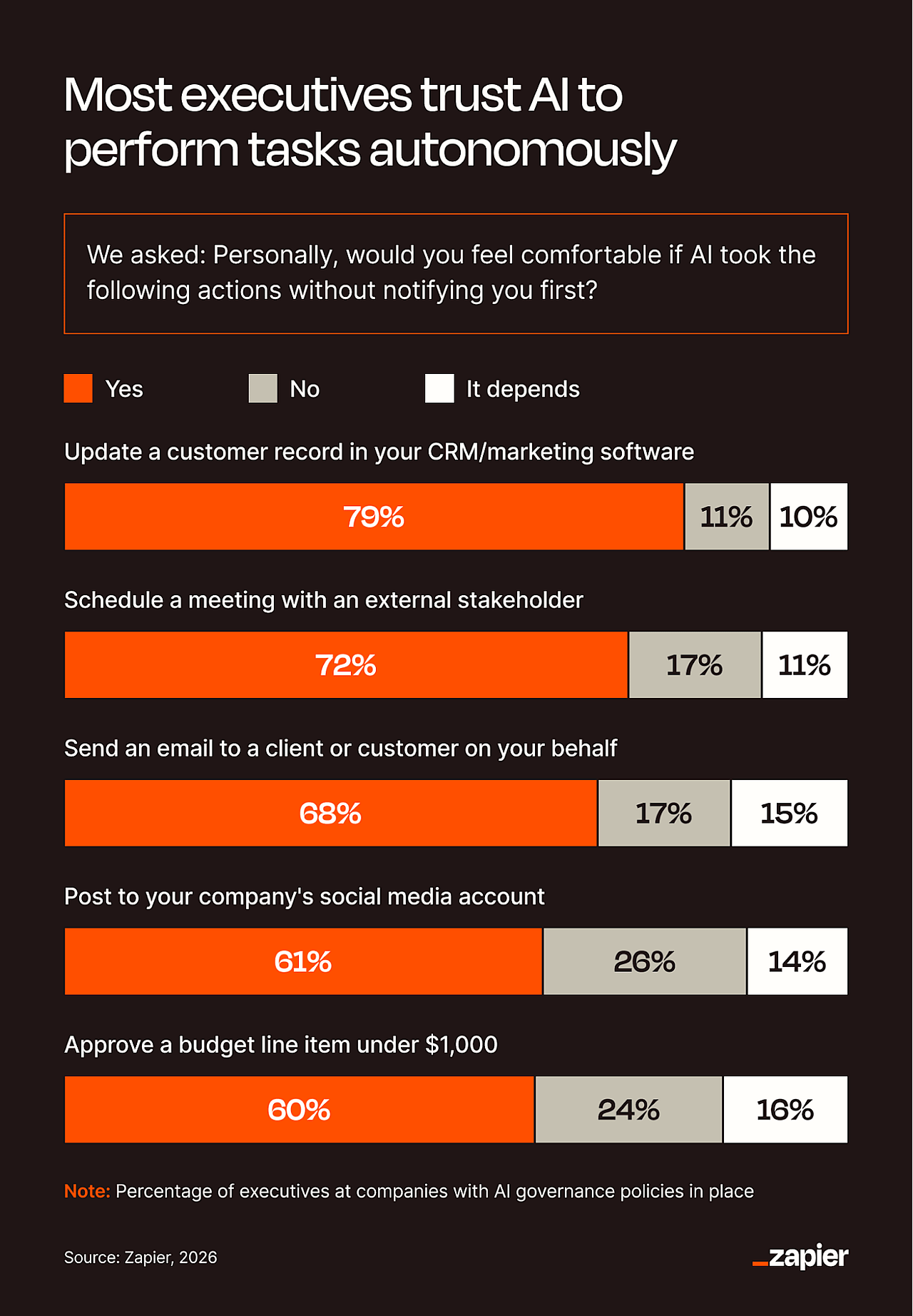
That trust has a ceiling, and it tracks almost perfectly with stakes. Most executives (79%) are ok with AI updating a customer record in their CRM or marketing software without telling them first, and 72% would accept AI scheduling a meeting with an external stakeholder without being notified.
But fewer executives are comfortable with AI handling slightly more high-stakes tasks without notifying them first, such as approving a budget line item under $1,000 (60%) or posting to their company's social media account (61%). Apparently, an AI agent can rearrange the executive calendar all it wants. Touch the budget, and most want a human in the room.
Human-in-the-loop requires strategic oversight and strong tooling
Executives are clearly willing to give AI control beyond busywork. The question is where to spend your review capacity, and the data points to three places:
- Gate on regulation: 66% of companies set AI approval policies around regulatory or compliance requirements. This is the least controversial checkpoint and the most expensive one to skip—36% of executives who had problems faced legal or compliance consequences.
- Gate on reversibility: 52% bring in human approval based on whether an action can be undone. Forgetting to send a Zoom link costs 10 minutes, while a typo-ridden email to a client costs a relationship. Sort your agent's actions by which ones you can take back.
- Gate on dollar value, then vary by team: 49% set approval thresholds by dollar value or business impact, and 62% vary the policy by department or function. Legal and Finance need tighter gates than the team generating boilerplate code that never leaves the building.
What none of these require is a person watching every step. The 26% approving every feasible action aren't getting better output than the 30% who intervene only on high-stakes work. They're just spending more to get it.
Regardless of which method you use, you don't need to backpedal and switch to dial-up to have better internet policies, and you don't need humans to micromanage autonomous workflows to use AI safely. Creating the best AI-powered work is a team effort between you, your agents, and the tools that you use to manage it all.
Methodology
The survey was conducted by Centiment on behalf of Zapier. The survey was fielded between July 1, 2026, and July 7, 2026. The results are based on 518 completed surveys. To qualify, respondents had to be U.S. directors, VPs, and C-suite executives at companies with an AI governance policy and at least 100 employees. Respondents were knowledgeable about the company's decisions regarding company AI use, including strategy, compliance, or governance. Data is unweighted, and the margin of error is approximately ±4% for the overall sample with a 96% confidence level. For this survey, a formal AI governance policy was defined as a documented, company-wide policy that addresses at least one of the following areas: approved or prohibited AI tools; data-handling rules for AI use; employee guidelines or training requirements; or compliance and monitoring procedures. Formal AI governance policies do not include informal norms, unwritten expectations, or manager-level guidance.
This story was produced by Zapier and reviewed and distributed by Stacker.